

Parke’s Name-Brand Phenomenon: How a Mockneck With a Last Name Became a Gen Z Status Symbol
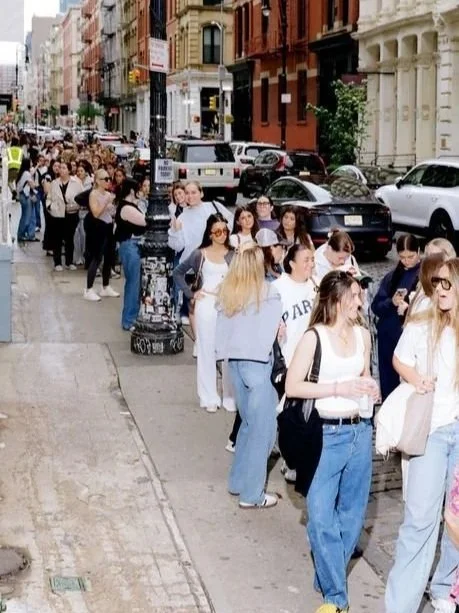
A few years ago, if you told me college girls would be lining up in SoHo—voluntarily, early, without a concert involved—for a $125 sweatshirt that basically says someone else’s last name across the chest, I would’ve asked what kind of sociological experiment you were running.
And yet, here we are.
Parke, the influencer-founded brand launched in 2022 by Chelsea Kramer (whose middle name is Parke), has pulled off something most fashion brands spend decades chasing: it became an “it” item without a celebrity face, without traditional advertising, and without needing to convince people it’s cool—because the internet did that part for them. In 2024, the brand reported $16 million in revenue, and its sales reportedly grew 950% from February 2024 to February 2025.
So how did a three-year-old company start moving like a legacy giant? And why are people either obsessed with wearing “PARKE” like it’s their own surname—or rolling their eyes so hard they can see their brain?
Let’s get into it.
The product strategy: basics, but make it a “uniform”
Parke’s hero product is the mockneck sweatshirt—thick, oversized, and embroidered in a collegiate font that feels like it came straight out of a 2006 campus bookstore… if that bookstore were curated by TikTok. The pricing alone signals what Parke is selling: this isn’t a random hoodie you toss on; it’s an item—typically $125–$135 for the mockneck styles on the brand’s site.
The brand’s strength is that it makes “basic” feel like a decision. The mockneck isn’t revolutionary in design, but it hits the sweet spot of what people actually wear: cozy, simple, easy to style, and flattering in that effortless way that says “I have my life together” even if you ate cereal for dinner.
And crucially, it’s instantly recognizable. In a sea of neutral loungewear, Parke figured out how to make a sweatshirt function like a badge.
The marketing strategy: no ads, all obsession
One of Parke’s most repeated flexes is that it scaled without spending on ads. Inc. reported the company grew from $100,000 in sales to $16 million over about three and a half years, “without spending a single dollar on ads.” That’s not just a cute founder story—it's the clearest clue to the strategy.
Parke didn’t buy attention. It is a manufactured belonging.
Chelsea Kramer herself is the marketing engine: she previews drops by wearing pieces casually, narrates behind-the-scenes decisions, and builds a feeling that customers are part of a small, stylish club. The Cut described Parke’s mocknecks as a campus status symbol and highlighted how Kramer teases new styles on her own account, turning the founder into both a tastemaker and a storefront.
That founder-led model is powerful because it creates a parasocial effect: people don’t just want the sweatshirt—they want the proximity to the lifestyle and the person.
The pop-up strategy: streetwear tactics for girls who love matcha
Parke’s pop-ups are where the “legacy brand” energy really kicks in. Forbes reported that over 3,500 people lined up around the SoHo block for one of Parke’s New York pop-ups, and The Cut described lines wrapping around the block during a three-day event.
This is straight out of the streetwear playbook: make it scarce, make it physical, make it feel like an event, and let the line itself become marketing.
When a brand has a line, the line becomes proof. Proof that it’s worth it. Proof that you’re not crazy for wanting it. Proof that if you don’t buy it now, you’ll regret it. And in the age of TikTok, the line is also content—free, nonstop, self-propagating content.
The “last name” question: why people love wearing “PARKE.”
This is the part that fascinates me most. Because objectively, wearing someone else’s name is a little… funny. Like, am I joining the Parke family? Did I inherit an estate? Should I be at Thanksgiving?
But here’s why it works:
Parke hits the same cultural nerve as old-school collegiate gear. Wearing a Harvard sweatshirt has never meant you went to Harvard—it means you like the symbolism. Parke is doing that, just faster and more digitally. The mockneck reads like a “cool campus” uniform even if you’re nowhere near a campus.
It also signals taste in a very specific way. The sweatshirt says: I’m online enough to know what this is, I’m in the loop, and I’m willing to spend for a vibe. That’s social currency—especially in spaces where everyone is trying to look effortless while also clearly being intentional.
And, honestly, it’s fun. People like recognizable items because they create micro-interactions: “Wait, is that Parke?” “What color is that?” “When did you get it?” Those tiny moments are a big reason why status pieces spread.
The other side: why people don’t like it (and why the criticism sticks)
Of course, not everyone finds it charming.
First, there’s the basic objection: why am I paying $125 to be a walking advertisement? Some people see the big “PARKE” logo and feel like they’re buying into hype more than substance.
Second, scarcity can cross the line from “exclusive” to “annoying.” The Cut reported drops selling out extremely fast and described backlash from customers who couldn’t check out in time—one even posted a tearful video after missing a release. Scarcity drives desire, but it can also create resentment, especially when the brand becomes popular faster than its inventory can support.
Third, there’s been debate about sourcing and transparency. The Daily Dot reported on controversy and criticism sparked by allegations around bulk sourcing/“white labeling.” Even if a customer doesn’t fully understand supply chains (most people don’t—and honestly, that's fair), the idea that they may be paying premium pricing for something they could find elsewhere can sour the magic.
In other words, Parke wins when it feels like a special insider product. It loses when it feels like a markup with good branding.
The replication era: everyone wants a Parke moment
The clearest sign Parke has cultural power is that the market is already trying to clone it.
By late 2025, outlets were publishing lists of “Parke dupes” and similar mocknecks—including alternatives from more mainstream retailers. You can also find “dupe” discourse all over social platforms, from budget-friendly versions to Etsy-style embroidered takes—because once a silhouette becomes a status marker, the whole ecosystem rushes in to recreate the look at different price points.
And it’s not just about copying a sweatshirt. Brands are copying the mechanics: limited drops, founder-as-face, pop-up frenzy, “community” language, and a single hero product that’s endlessly iterated through colorways.
The business story in numbers: the growth curve that explains the hype
Parke’s rise is one of those startup timelines that reads like a pitch deck. Forbes reported growth from $100k in 2022 to $1M in 2023, with the brand projecting major growth into 2024. By 2024, multiple outlets reported the brand hit $16M. And with sales reportedly up 950% year-over-year (Feb to Feb), it’s clear the mockneck wasn’t just a viral moment; it was a scalable business driver.
That kind of growth doesn’t happen from product alone. It happens when a brand nails the loop: attention, scarcity, social proof, repeat demand.
The UnFold take:
Parke is proof that the new “legacy brand” isn’t built in department stores—it’s built in comment sections.
The mockneck works because it’s not just a sweatshirt. It’s a signal: of taste, of belonging, of internet literacy, of being in on something. Wearing “PARKE” is basically saying, “Yes, I’m part of the group chat.”
But the same tactics that built the obsession—scarcity, drops, rapid growth—also create the backlash. Once a brand becomes status-driven, people start asking harder questions: Is it worth it? Is it ethical? Is it hype? Is it quality? And those questions get louder as soon as the trend hits saturation and dupes flood the market.
If Parke’s next chapter is about becoming a true long-term brand (not just a perfect moment), the challenge will be keeping the magic while scaling access, and backing up the aesthetic with transparency that feels as solid as the sweatshirt looks.
I caved. After weeks of seeing it in OOTDs, coffee runs, airport fits, and mirror selfies, I finally bought the Parke mockneck. The one with the last name stitched across the front like I’m repping a family I was never formally introduced to.
First impression: it felt good. Heavy in a reassuring way, not flimsy. Structured, but still soft. The mockneck sat perfectly, not choking, not slouchy, and immediately gave off that “I didn’t try, but I definitely thought about this” energy. I threw it on with jeans and slicked-back hair and, suddenly, I understood the hype a little too well.
At the same time, I get the criticism now more than ever. Wearing someone else’s name is strange when you stop and think about it. And once the initial thrill wears off, you do start asking yourself if you paid for quality, branding, or belonging—or some mix of all three.
Still, I don’t regret it. I’ve worn it more times than I expected, styled it more ways than I thought I would, and felt that little internal “okay, cute” moment every time I put it on. And honestly? That reaction is exactly what Parke is selling.
Did I buy a sweatshirt? Yes.
Did I also buy the feeling of being in on something? Absolutely.
And that’s why the strategy works; on me, and on thousands of other people pulling the same mockneck over their heads and thinking, yeah… I get it now.
I am typically against a trend that will most likely expire within a few months, but I figured it is okay to partake every once in a while.
With love,
Avery Fritsch
Author of UnFold